3. Prerequisites and technical details
3.1. Actors registration
PSD2 actors must be registered by a registration authority. The information that has been collected must be accessible to other actors in order to provide trust and interoperability.
A non-registered actor cannot interact with another actor.
Each actor must be provided with at least one eIDAS certificate (QWAC), for TLS 1.2 purpose, delivered by a registered Qualified Trust Service Provider (QTSP).
The European Commission list of QTSPs can be retrieved at the following URL:
https://esignature.ec.europa.eu/efda/tl-browser/#/screen/home
3.2. Cross-Authentication and Data Encryption
The STET PSD2 API relies on TLS 1.2 protocol in order to get cross-authentication between actors. Moreover, this protocol also ensures data confidentiality during their transport on the network.
Whenever a TPP connects as a client to an ASPSP API service, it will check the ASPSP server certificate (QWAC) and present its own eIDAS certificate (QWAC) respecting the ETSI/TS119495 Technical Specification.
The Organisational Identification within the Subject Distinguished Name of the certificate should actually be regarded as an Authorization Number that will respect the following format rules:
-
"PSD" as 3-character legal person identity type reference;
-
2-character ISO 3166 [7] country code representing the NCA country;
-
hyphen-minus "-" (0x2D (ASCII), U+002D (UTF-8)); and
-
2-8-character NCA identifier (A-Z uppercase only, no separator);
-
hyphen-minus "-" (0x2D (ASCII), U+002D (UTF-8)); and
-
PSP identifier (authorization number as specified by the NCA).
In case of authentication failure, on one side or the other, the connection must be closed.
No additional encrypting or authenticating feature is required.
3.3. Customer Authentication Approaches
Three different approaches can be used by a TPP to allow the PSU authentication by the ASPSP. These approaches rely on a PSU identification that must be relevant to the ASPSP (National identifier or Bank customer identifier).
These approaches are implemented in different ways, depending on the relevant use case:
-
either during the authorisation process (cf. §3.4.2), mostly for AISP and CBPII use cases,
-
or during the consent confirmation process, for instance in case of a PISP submitting a Payment Request (cf. § 3.4.2).
3.3.1. Redirect Approach
Through the Redirect approach, the PSU authentication process is fully processed by the ASPSP.
In order to allow this, the TPP has to redirect the PSU to the ASPSP authentication service, meaning the PSU will leave temporarily the TPP interface for authenticating towards the ASPSP interface.
The TPP might have already captured a PSU identifier that can be handled by the ASPSP for unambiguously recognizing the PSU. In this case this identifier might be forwarded through the redirection, when the redirect protocol allows the forwarding of this identifier.
After finalisation of the authentication, the ASPSP redirects the PSU back to the TPP interface.
3.3.2. Decoupled approach
Through the Decoupled approach, the PSU authentication process is fully processed by the ASPSP.
In order to allow this the TPP has to capture a PSU identifier that can be handled by the ASPSP for unambiguously recognizing the PSU, and to forward this identifier to the ASPSP.
Based on this identifier, the ASPSP will trigger an authentication through a decoupled device or application, meaning that the PSU will not leave the TPP interface during the authentication process.
3.3.3. Exemptions to Strong Customer Authentication
Exemptions to Strong Customer Authentication are specified by the EBA RTS on SCA, especially for Payment Initiation Services.
In this context, the API allows the PISP to forward to the ASPSP any useful information.
Moreover, the PISP may also hint the ASPSP on whether or not the relevant payment request could be subject to an exemption.
Eventually, the ASPSP keeps the final decision to apply or not this exemption.
3.4. Authorization
3.4.1. Levels of authorization
The following levels of authorization may be checked and combined in order to compute the effective rights granted to the TPP:
| AUTHORIZATION LEVEL | DESCRIPTION |
|---|---|
| Authorization by TPP role | Once the TPP has been registered for a given role, it can call any of the PSD2 features provided by an ASPSP through the STET PSD2 API for this role. |
| Authorization by TPP-ASPSP agreement | The TPP can call any of the additional (non PSD2) features provided by an ASPSP through the STET PSD2 API, provided there is a bilateral agreement to use these features. |
| Authorization by TPP-PSU agreement | If the PSU has contracted with a TPP, he/she must - Give a list of the ASPSPs that he/she allows the TPP to access - Process an authentication against each of those relevant ASPSPs that will further allow the TPP to access the PSU data. |
| Authorization by PSU context | The PSU is able to specify his/her PSU context detailing, for each of its relevant accounts: - If this account will be accessible or not by the TPP - Which features can be used by the TPP The PSU can modify at any time his/her PSU context. |
3.4.2. Technical basis
The TPP is authorized to access the ASPSP's API through an access token that can be
retrieved through the OAuth2 Authorisation Framework (https://tools.ietf.org/html/rfc6749).
Different authorisation grants can be used, depending on the TPP's role and use case to be applied.
The TPP may need to handle multiple OAuth2 tokens provided by a given ASPSP on behalf of a given PSU. Actually, the request of a new OAuth2 token must not imply the revocation of a previous one.
3.4.2.1. TPP Identity matching
The OAuth2 protocol is enforced by checking the identity of the TPP during the OAuth2 procedures through the TPP's eIDAS certificate, based on MTLS (https://datatracker.ietf.org/doc/rfc8705/).
This enforcement is obtained by the mandatory provisioning by the TPP of a [client_id] field within all OAuth2 request. This [client_id] must match, directly or not, with the Authorisation Number located within the TPP's eIDAS certificate and this match must be checked by the ASPSP for each OAuth2 request.
Since MTLS is used, the use of the [client_secret] is not very useful but can nevertheless been required by some authorisation servers. Each implementation requiring the use of a [client_secret] must update its documentation on this topic.
Direct matching
The match can be obviously direct when the [client_id] is equal to the Authorisation Number.
In this case the ASPSP's API MANAGER might be able to check and accept "on the fly" the OAuth2 request.
Indirect matching
However, in some cases, especially when the API MANAGER is unable to process an "on the fly" registration, an OAuth2 technical setup should occur prior to any OAuth2 token request. This setup will result by the provisioning of a [client_id] value by the ASPSP to the TPP.
-
The provisioning of multiple [client_id] values that could be used for different use cases by the TPP is possible through replaying the setup.
-
Moreover, the setup allows the exchange of operational data between the TPP and the ASPSP for further use: logos, phone numbers, email addresses, certificates…
Eventually, this setup can be automated.
3.4.2.2. Automated OAuth2 technical setup
Principles
While most of the API managers provide an inline setup interface, this setup can also be automated.
The RFC 7591 specifies an interactive dynamic protocol that allows a client to provision some context metadata and get a [client_id] value. There is no restriction to provide several [client_id] values for the same client and context metadata. Nevertheless, the number of [client_id] requested by a same client must remain reasonable and motivated by a real need. As a complement, RFC 7592 specifies how to retrieve, modify or delete a previously posted context.
If several usage contexts are needed for a given API client, this client will have to reiterate the complete process to get as many [client_id] values as needed.
Actually, some TPPs might be client of an API on behalf of an agent (Article 4-38 of PSD2). Each agent should be considered as a specific usage context.
As this protocol is not mandatory, each API implementation will have to specify whether or not it is implemented.
Context metadata
The relevant metadata items to provide are listed below:
| CLIENT METADATA NAME | CLIENT METADATA DESCRIPTION | REQUIREMENT | CHANGE CONTROLLER | REFERENCE |
|---|---|---|---|---|
| redirect_uris | Array of redirection URIs for use in redirect-based flows | Mandatory | IESG | [RFC7591] |
| software_statement | JSON Web Token (JWT) that asserts metadata values about the client software as a bundle | Optional | IETF | [RFC7591] |
| token_endpoint_auth_method | Requested authentication method for the token endpoint. | Mandatory According to the RFC8705 (cf. § 2.1.1), the value to be used will be "tls_client_auth" as soon as the draft will be promoted as an RFC. | IESG IETF | [RFC7591] [RFC8705] |
| CLIENT METADATA NAME | CLIENT METADATA DESCRIPTION | REQUIREMENT | CHANGE CONTROLLER | REFERENCE |
|---|---|---|---|---|
| tls_client_auth_subject_dn | Indicates the certificate subject value that the authorization server is to expect when authenticating the respective client. | Mandatory An [RFC4514] string representation of the expected subject distinguished name of the certificate, which the OAuth client will use in mutual-TLS authentication. | IETF | [RFC8705] |
| grant_types | Array of OAuth 2.0 grant types that the client may use | Mandatory Allowed values are: - "authorization_code" - "ciba" - "client_credentials" - "refresh_token" | IESG | [RFC7591] |
| response_types | Array of the OAuth 2.0 response types that the client may use | Optional "code" is the sole allowed value | IESG | [RFC7591] |
| client_name | Human-readable name of the client to be presented to the user | Mandatory Must specify the name of the agent or by default the name of the TPP. | IESG | [RFC7591] |
| client_uri | URL of a web page providing information about the client | Optional | IESG | [RFC7591] |
| logo_uri | URL that references a logo for the client | Optional | IESG | [RFC7591] |
| scope | Space- separated list of OAuth 2.0 scope values | Optional | IESG | [RFC7591] |
| contacts | Array of strings representing ways to contact people responsible for this client, typically email addresses | Mandatory At least one contact must be provided. | IESG | [RFC7591] |
| tos_uri | URL that points to a human- readable terms of service document for the client | Optional | IESG | [RFC7591] |
| policy_uri | URL that points to a human- readable policy document for the client | Optional | IESG | [RFC7591] |
| provider_legal_id | Authorization number of the TPP according to ETSI specification on eIDAS certificates for PSD2 | Mandatory | STET (to be registered) |
| CLIENT METADATA NAME | CLIENT METADATA DESCRIPTION | REQUIREMENT | CHANGE CONTROLLER | REFERENCE |
|---|---|---|---|---|
| client_legal_id | Authorization number of the agent see below) | Mandatory in case of an agent which is distinct from the TPP | STET (to be registered) | |
| logo | base64 encoded value of the logo | Optional | STET (to be registered) | |
| jwks | Client's JSON Web Key Set [RFC7517] document value, which contains the client's public keys. | Optional The value of this field MUST be a JSON object containing a valid JWK Set. These keys can be used by higher-level protocols that use signing or encryption. | IESG | [RFC7591] |
In a similar way to the ETSI specification on the Authorization Number for TPPs, the agent
Authorization Number must respect the following format:
-
"AGT" as 3-character legal person identity type reference;
-
2-character ISO 3166 country code representing the NCA country;
-
- hyphen-minus "-" (0x2D (ASCII), U+002D (UTF-8)); and
-
2-8-character NCA identifier (A-Z uppercase only, no separator);
-
hyphen-minus "-" (0x2D (ASCII), U+002D (UTF-8)); and
-
Agent identifier (registration number as specified by the NCA).
-
Interactions
The TPP submits its context metadata through a
POST /register
In response, it gets this context metadata completed by
-
the relevant [client_id]
-
an optional [client_secret] that is not really useful since the authentication of the client is already done though MTLS.
-
the [registration_client_uri] as an endpoint for configuration of the client
-
the [registration_access_token] to be used for accessing the configuration of the client.
-
its issuing timestamp.
RFC7591 allows the server to update some of the context metadata if needed.
At any time, the TPP can retrieve the context metadata through a
GET /register/{client_id}
Updating the context metadata can be done through a
PUT /register/{client_id}
And deleting the context metadata is possible through a
DELETE /register/{client_id}
3.4.2.3. OAuth2 Authorization Code Grant
The authorisation process might rely on an OAuth2 sequence for obtaining an Authorization Code Grant token (cf. https://tools.ietf.org/html/rfc6749#section-4.1) and implements the REDIRECT approach.
This kind of token, depending on the ASPSP implementation:
-
Can be used for all AISP use cases;
-
Can be used for the CBPII use case;
-
Can be used for the PISP confirmation use case.
The process can be summarized through the following steps.
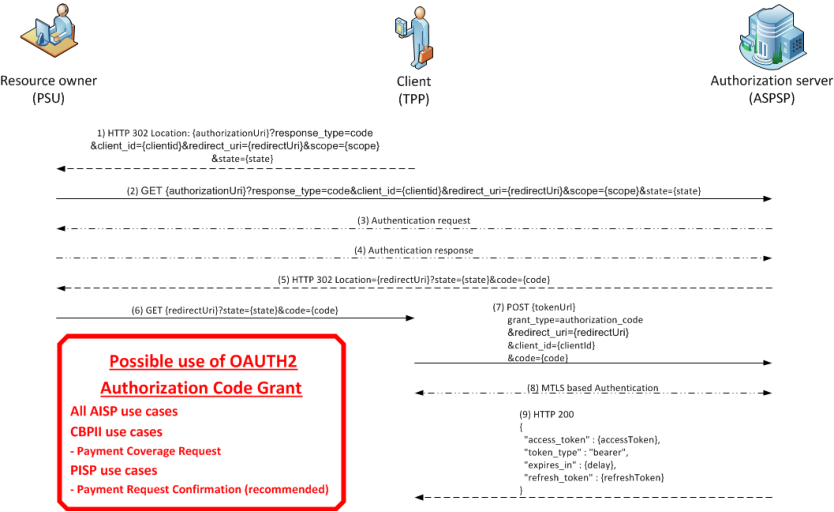
At first, the PSU must specify to the TPP, the identity of one of its ASPSPs.
Optional Code verifier and challenge
Some authorization server may ask for implementation of RFC7636 (PKCE: Proof Key for Code Exchange ) in order to enforce the OAuth2 Autorization Code grant.
Therefore, the client must as a first step create a code verifier and a code challenge.
Authorization Request
The TPP initiates the OAuth2 sequence by redirecting the PSU to the relevant ASPSP's authorization infrastructure, through the following URL pattern and parameters
Since this is done by a redirection of the PSU, the eIDAS of the TPP cannot be presented at this stage.
GET /authorize?response_type=code&client_id=&redirect_uri=&scope=[&state=]
| NAME | DATA | TYPE AND CONSTRAINS | |
|---|---|---|---|
| response_type | [1..1] | Expected type of token | String[10] Must be valued with"code" |
| client_id | [1..1] | TPP identification | String[36] must be equal or linked to the OrganizationIdentifi er part of the Distinguished Name of the eIDAS certificate, according to ETSI specification |
| redirect_uri | [0..1] | Call-back URL of the TPP | String[140] |
| scope | [0..1] | Specifies the generic accreditations that both the PSU and the TPP agreed on: - For AISP oaisp oextended_transaction_history - for CBPII ocbpii - for PISP opisp | String[140] Space delimited roles list. Mandatory |
| state | [0..1] | Internal state that can be used by the TPP for context management. | String[1024] Recommended |
| code_challenge | [0..1] | Code challenge as computed by the TPP according to RFC 7636 | String[140] Required if implementation of RFC7636 is mandated by the Authorization Server |
| code_challenge_meth od | [0..1] | Code challenge method use by the TPP for computing the code challenge | "S256" or "plain" Default value equals to"plain" |
Notice: The RFC 6749 does not specify the Authorization Code Grant to support the forwarding of the Resource Owner (PSU) user name or language preferences.
However, some OpenID Connect features might be used for these purposes even though the OpenID Connect specification is not fully applied (cf. § 3.4.2.4).
Moreover, this specification suggests a Token Introspection implementation (cf. § 3.4.2.7) whose parameters could be helpful to determine the PSU identity and usage context.
These additional parameters are summarized in the following table.
| NAME | DATA | TYPE AND CONSTRAINS |
|---|---|---|
| login_hint_token | A token containing information identifying the end-user for whom the token was issued. This information can also include the specific usage context if needed. The particular details and security requirements for this element as well as how the end-user is identified by its content are specific to each ASPSP implementing this functionality. This token would have been retrieved through a token introspection request (cf.§ 3.4.2.7) | String [2048] |
| ui_locales | End-User's preferred languages and scripts for the user interface. | String [140] End-User's preferred languages and scripts for the user interface, represented as a space-separated list [RFC 5646] |
| login_hint | Hint to the Authorization Server about the login identifier the End- User might use to log in (if necessary). | String[36] |
The ASPSP
-
Identifies and authenticates the PSU
-
Computes the relevant TPP checks (roles, validity, non-revocation…)
-
Checks the [redirect_uri] against the ones that might have been declared during the automated OAuth2 technical setup (cf. § 3.4.2.2). The provided [redirect_uri] must exactly match one those that have been registered.
-
Registers the [code_challenge] and [code_challenge_method] with the code request when implementation of RFC 7636 is mandated.
Authorization Response
Afterwards, the ASPSP redirects the PSU to the TPP, using the previously given call-back URL (redirect_uri) and the following parameters:
| NAME | DATA | TYPE AND CONSTRAINS | ||
|---|---|---|---|---|
| code | [1..1] | Short-time code to use in order to get the access token | String[36] | |
| state | [0..1] | Internal state if provided by theTPP | String[1024] Recommended |
The recommended lifetime of the authorization code as specified by the RFC 6749 is 10 minutes but it is up to the authorization server to set its own lifetime value.
Access Token Request
In order to get the access token, the TPP is now able to call, through a POST request, the ASPSP's authorization infrastructure with the following parameters.
POST /token HTTP/1.1 Host: server.example.com grant_type=authorization_code &code= &redirect_uri= &client_id=
| NAME | DATA | TYPE ANDCONSTRAINS | ||
|---|---|---|---|---|
| grant_type | [1..1] | Requested authorization type | String[36] Must be valued with"authorization_code" | |
| code | [1..1] | Short-time code previously provided by the ASPSP | String[36] | |
| redirect_uri | [0..1] | Call-back URL of the TPP | String[140] Must be equal to the one provided during the authorization code request | |
| client_id | [1..1] | TPP identification. | String[36] must be equal or linked to the OrganizationIdentifier part of the Distinguished Name of the eIDAS certificate, according to ETSI specification | |
| client_secret | [0..1] | The client secret | Since authentication of the client TPP is provided through MTLS, this parameter is not very useful. | |
| code_verifier | [0..1] | RFC7636 code verifier that was initially set by the TPP | Required when implementation of RFC7636 is mandated by the Authorization Server |
-
The ASPSP
-
Identifies and authenticates the TPP through the presented eIDAS certificate (QWAC)
-
Checks the direct or indirect matching between the Authorization Number within the eIDAS certificate and the [client_id] value.
-
Computes the relevant TPP checks (roles, validity, non-revocation…)
-
Verifies the [code_verifier] value by recalculating the [code_challenge].
-
Access Token Response
- The ASPSP answers through a HTTP200 (OK) response that embeds the following data.
| NAME | DATA | TYPE AND CONSTRAINS | |
|---|---|---|---|
| access_token | [1..1] | Access token provided by the ASPSP to the TPP. | String[140] |
| token_type | [1..1] | Type of the provided access token ("Bearer" or "MAC") | String[10] Must be valued with "Bearer" |
| expires_in | [0..1] | Token lifetime, in seconds. The token can be used several times as far as it is not expired. | Numeric |
| refresh_token | [0..1] | Refresh token that can be used for a future token renewal request. | String[140] |
3.4.2.4. OpenID Connect extension to the OAuth2 Authorization Code Grant
« As an optional feature, an authorization server may implement the OpenID Connect Core 1.0 » specification on top of the OAuth2 "Authorization Code" flow.
The OpenID Connect protocol allows the API client (TPP) to get from the API server (ASPSP) an IdToken that will certify the identity of the PSU, once this PSU has been authenticated by the ASPSP.
Simple Authentication request
The Open Id Connect Authentication Request relies on the OAuth2 "Authorization Code" Authorization Request with some additional parameters, marked as bold in the following diagram)requirement.
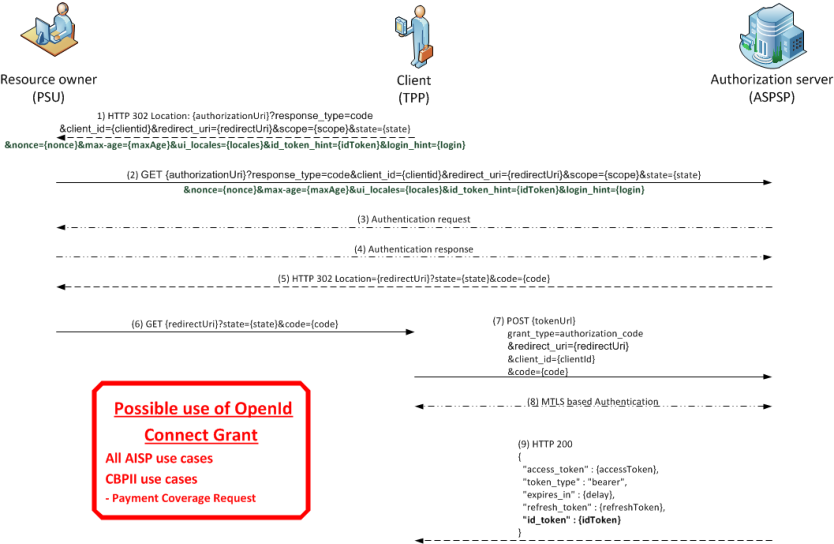
s:
| NAME | DATA | TYPE AND CONSTRAINS | |
|---|---|---|---|
| response_type | [1..1] | Expected type of token | String[10] Must be valued with "code" |
| client_id | [1..1] | TPP identification | String[36] must be equal or linked to the OrganizationIdentifier part of the Distinguished Name of the eIDAS certificate, according to ETSI specification |
| redirect_uri | [0..1] | Call-back URL of the TPP | String[140] |
| Scope | [0..1] | Specifies the generic accreditations that both the PSU and the TPP agreed on: - For AISP oaisp oextended_transaction_history - for CBPII ocbpii. - In any case oopenid ooffline_access | String[140] Space delimited roles list. additional scopes are required -openid for specifying the use of OpenID Connect -offline_access to allow the retrieval of a refresh token within the OpenID context. |
| State | [0..1] | Internal state that can be used by the TPP for context management. | String[1024] |
| Nonce | [0..1] | Association of a client session with an Id token used to mitigate replay attacks | String[36] |
| max-age | [0..1] | Maximum authentication age (in seconds) | String[15] |
| NAME | DATA | TYPE AND CONSTRAINS | |
|---|---|---|---|
| ui_locales | [1..1] | End-User's preferred languages and scripts for the user interface. | String [140] End-User's preferred languages and scripts for the user interface, represented as a space-separated list[RFC 5646] Required by the API |
| id_token_hint | [0..1] | last known IdToken for the end-user (PSU), if any. | String [2048] |
| login_hint | [0..1] | Hint to the Authorization Server about the login identifier the End-User might use to log in (if necessary). | String[36] |
| Login_hint_token | [0..1] | A token containing information identifying the end-user for whom the token was issued. This information can also include the specific usage context if needed. The particular details and security requirements for this element as well as how the end-user is identified by its content are specific to each ASPSP implementing this functionality. This token would have been retrieved through a token introspection request (cf.§ 3.4.2.7) | String [2048] |
The [id_token_hint] parameter is quite useful to ease a PSU authentication request renewal by forwarding his/her already known identification. For a first authentication request the [login_hint] parameter can be used by the TPP to forward the PSU identification, as known by the ASPSP.
As for the OpenID Connect Authentication Request is based on the OAuth2 Authorization Request, the latest is enhanced in the following way:
GET /authorize? response_type=code &client_id=s6BhdRkqt3 &redirect_uri=https%3A%2F%2Fclient.example.org%2Fcb &scope= openid%20%offline_access%20% aisp & nonce=n-0S6_WzA2Mj & state=af0ifjsldkj HTTP/1.1 Host: server.example.com
Signed Authentication Request
The OpenID Connect Authentication Request can also be passed as a Signed Request Object if the Authorisation Server allows at.
The structure of this Signed Request Object is a Json Web Token (JWT) whose data includes:
-
the usual request parameters as specified above
-
some additional parameters relating to the signature (see https://openid.net/specs/openid-connect-core-1_0.html#RequestObject for details)
It must be noted that although the Signed Request Object supersedes the usual request parameters, the latest may also be passed alongside.
Authentication Response
Case of a successful processing of the request, the server will return an authorization code through the redirection of the PSU towards the TPP.
HTTP/1.1 302 Found Location: https://client.example.org/cb ? code=SplxlOBeZQQYbYS6WxSbIA &state=af0ifjsldkj
Token request
The TPP requests the exchange of the authorization code against an OAuth2 token.
POST /token HTTP/1.1 Host: server.example.com Content-Type: application/x-www-form-urlencoded grant_type=authorization_code&code=SplxlOBeZQQYbYS6WxSbIA &redirect_uri=https%3A%2F%2Fclient.example.org%2Fcb
NB: The « Authorization » header is useless since authentication is provided through MTLS, based on the TPP eIDAS certificate (https://datatracker.ietf.org/doc/rfc8705/).
Token response
The Authorization server answers with:
-
An OAuth2 access token
-
An OAuth2 refresh token
-
An IdToken
HTTP/1.1 200 OK Content-Type: application/json Cache-Control: no-store
Pragma: no-cache
{ "access_token": "SlAV32hkKG", "token_type": "Bearer", "refresh_token": "8xLOxBtZp8", "expires_in": 3600, "id_token": "eyJhbGciOiJSUzI1NiIsImtpZCI6IjFlOWdkazcifQ.ewogImlzc yI6ICJodHRwOi8vc2VydmVyLmV4YW1wbGUuY29tIiwKICJzdWIiOiAiMjQ4Mjg5 NzYxMDAxIiwKICJhdWQiOiAiczZCaGRSa3F0MyIsCiAibm9uY2UiOiAibi0wUzZ fV3pBMk1qIiwKICJleHAiOiAxMzExMjgxOTcwLAogImlhdCI6IDEzMTEyODA5Nz AKfQ.ggW8hZ1EuVLuxNuuIJKX_V8a_OMXzR0EHR9R6jgdqrOOF4daGU96Sr_P6q Jp6IcmD3HP99Obi1PRs-cwh3LO-p146waJ8IhehcwL7F09JdijmBqkvPeB2T9CJ NqeGpe-gccMg4vfKjkM8FcGvnzZUN4_KSP0aAp1tOJ1zZwgjxqGByKHiOtX7Tpd QyHE5lcMiKPXfEIQILVq0pc_E2DzL7emopWoaoZTF_m0_N0YzFC6g6EJbOEoRoS K5hoDalrcvRYLSrQAZZKflyuVCyixEoV9GfNQC3_osjzw2PAithfubEEBLuVVk4 XUVrWOLrLl0nx7RkKU8NXNHq-rvKMzqg" }
IdToken structure
The structure of the IdToken is a Json Web Token (JWT).
In the previous example, the following data is included:
{ alg: "RS256", kid: "1e9gdk7" }. { iss: " "http://server.example.com" ", sub: "248289761001", aud: "s6BhdRkqt3", nonce: "n-0S6_WzA2Mj", exp: 1311281970, iat: 1311280970 }. [signature]
The possible data items are described in the following table:
| FIELD | REQUIREMENT | DESCRIPTION |
|---|---|---|
| iss | Mandatory | Tokenprovider identifier |
| sub | Mandatory | Token subject identifier |
| aud | Mandatory | Token recipient[client_id] |
| nonce | Conditional | Mandatory retrieval of the [nonce] parameter if present in the initial Authentication Request |
| exp | Mandatory | IdToken expiration date[RFC3339] |
| iat | Mandatory | IdToken creation date[RFC3339] |
| auth_time | Conditional | End-user (PSU) authentication date and time ["https://tools.ietf.org/html/rfc3339"] when the [max_age] parameter is present in the initial Authentication Request |
3.4.2.5. Client Initiated Backchannel Authentication Grant
This registration process is based on the OpenID FAPI Connect CIBA flow and implements the DECOUPLED approach. (https://openid.net/specs/openid-client-initiated-backchannelauthentication-core-1_0.html)
However, in order to avoid any preregistration step, this grant is supposed to use the polling mode as the sole way for getting the requested token.
This kind of token, depending on the ASPSP implementation:
-
Can be used for all AISP use cases;
-
Can be used for the CBPII use case;
Authorization Request
In order to get the access token, the TPP calls, through a POST request, the ASPSP's
authorization infrastructure with the following parameters.
POST /bc_authorize HTTP/1.1 Host: as.example.com client_id= &scope= &login_hint_token= &id_token_hint= &login_hint= &binding_message= &ui_locales=
| NAME | DATA | TYPE AND CONSTRAINS | |
|---|---|---|---|
| client_id | [1..1] | TPP identification | String[36] must be equal or linked to the OrganizationIdentifier part of the Distinguished Name of the eIDAS certificate, according to ETSI specification |
| scope | [1..1] | Specifies the generic accreditations that both the PSU and the TPP agreed on: - For AISP oaisp oextended_transaction_history - for CBPII ocbpii | String[140] Space delimited roles list. Mandatory |
| login_hint_token | [0..1] | A token containing information identifying the end- user whom the token was issued. This information can also include the specific usage context if needed. The particular details and security requirements for this element as well as how the end-user is identified by its content are specific to each ASPSP implementing this functionality. This token would have been retrieved through a token introspection request (cf.§ 3.4.2.7) | String [2048] |
| id_token_hint | [0..1] | An ID token previously issued to the Client in case the ASPSP has implemented The OpenID connect extensionto OAuth2. | String[36] |
| login_hint | [0..1] | Hint to the Authorization Server about the login identifier the End-User might use to log in (if necessary). | String[36] |
| binding_message | [0..1] | A human readable identifier or message intended to be displayed to the end-user. | String [140] |
| ui_locales | [0..1] | End-User's preferred languages and scripts for the user interface. | String [140] End-User's preferred languages and scripts for the user interface, represented as a space- separated list [RFC 5646] |
The ASPSP
-
Identifies and authenticates the TPP through the presented eIDAS certificate (QWAC)
-
- Checks the direct or indirect matching between the Authorization Number within the eIDAS certificate and the [client_id] value provided by the JWT
-
Computes the relevant TPP checks (roles, validity, non-revocation…)
-
Identifies the PSU and checks if a decoupled channel can be used
Authorization Response
In case of a successful request validation, the ASPSP answers to the TPP through a HTTP200 (OK) response that embeds the following data.
| NAME | DATA | TYPE AND CONSTRAINS | ||
|---|---|---|---|---|
| auth_req_id | [1..1] | Unique identifier for the authorization request. | String[36] | |
| expires_in | [1..1] | Expiration time in seconds of the authorization request identifier | Number | |
| interval | [0..1] | Minimum amount in seconds that the TPP must wait between polling requests. | Number |
Meanwhile, the ASPSP contacts the PSU on the relevant decoupled channel, displays the authorization request content and asks for confirmation through an authentication.
Access Token Request
The TPP may then poll the token endpoint with the interval provided by the authorization response.
POST /token HTTP/1.1 Host: as.example.com client_id= &grant_type= &auth_req_id=
| NAME | DATA | TYPE AND CONSTRAINS | |
|---|---|---|---|
| client_id | [1..1] | TPP identification | String[36] must be equal or linked to the OrganizationIdentifier part of the Distinguished Name of the eIDAS certificate, according to ETSI specification |
| client_secret | [0..1] | The client secret | Since authentication of the client TPP is provided through MTLS, this parameter is not very useful. |
| grant_type | [1..1] | Grant type | Must be equal to "urn:openid:params:grant-type:ciba" |
| auth_req_id | [1..1] | Authorization request unique identifier as provided through the Authorization response | String [36] |
Successful token response
The ASPSP answers through a HTTP200 (OK) response that embeds the following data.
| NAME | DATA | TYPE ANDCONSTRAINS | |
|---|---|---|---|
| access_token | [1..1] | Access token provided by the ASPSP to the TPP. | String[140] |
| token_type | [1..1] | Type of the provided access token ("Bearer" or "MAC") | String[10] Must be valued with "Bearer" |
| NAME | DATA | TYPE AND CONSTRAINS | |
|---|---|---|---|
| expires_in | [0..1] | Token lifetime, in seconds. The token can be used several times as far as it is not expired. | Numeric |
| refresh_token | [0..1] | Refresh token that can be used for a future token renewal request. | String[140] |
Unsuccessful token response
In addition to the error codes that are already specified by RFC6749, the following values can also be used in the context of a HTTP400 response.
| ERROR CODE | DESCRIPTION |
|---|---|
| authorization_pending | The authorization request is still pending as the end-user (PSU) has not yet been authenticated. In respect with the specified polling interval, the TPP will have to replay the token request. |
| slow_down | The authorization request is still pending as the end-user (PSU) has not yet been authenticated and the TPP will have to replay the token request. However, the polling interval must be increased by at least 5 seconds for this next request and all the subsequent ones. |
| expired_token | The authorization request identifier has expired. The TPP will need to make a new authorization request |
| access_denied | the end-user (PSU) denied the authorization request |
3.4.2.6. OAuth2 Client Credentials Flow
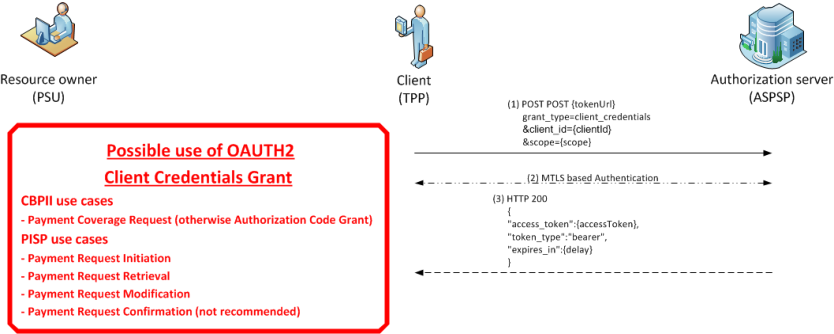
The registration of the TPP by the ASPSP relies on an OAuth2 sequence for obtaining a Client Credential grant token (cf. https://tools.ietf.org/html/rfc6749#section-4.4).
This kind of token, depending on the ASPSP implementation:
-
Can be used for the CBPII use case ;
-
Can be used for the PISP confirmation use case (basic REDIRECT Approach);
-
- Must be used for all others PISP use cases.
This procedure can be summarized through the following steps.
Access Token Request
The TPP sends directly, through a POST request, its access token request to the ASPSP authorization infrastructure with the following URL pattern and parameters
POST /token Host: authorization-server.com grant_type=client_credentials &scope= &client_id=
| NAME | DATA | DATA | TYPE AND CONSTRAINS | |
|---|---|---|---|---|
| grant_type | [1..1] | Requested authorization type | String[36] Must be valued with "client_credentials" | |
| scope | [0..1] | Specifies the generic accreditations that both the PSU and the TPP agreed on: PISP. | String[140] Space delimited roles list. Default value is "pisp" | |
| client_id | [1..1] | TPP identification | String[36] must be equal or linked to the OrganizationIdentifier part of the Distinguished Name of the eIDAS certificate, according toETSIspecification | |
| client_secret | [0..1] | The client secret | Since authentication of the client TPP is provided through MTLS, this parameter is notvery useful. |
The ASPSP
-
Identifies and authenticates the TPP through the presented eIDAS certificate (QWAC)
-
Checks the matching, direct or indirect, between the Authorization Number within the eIDAS certificate and the [client_id] value.
-
Computes the relevant TPP checks (roles, validity, non-revocation…)
Access Token Response
- The ASPSP answers through a HTTP200 (OK) response that embeds the following data.
| NAME | DATA | TYPE AND CONSTRAINS | ||
|---|---|---|---|---|
| access_token | [1..1] | Access token provided by the ASPSP to the TPP. | String[140] | |
| token_type | [1..1] | Type of the provided access token ("Bearer"or "MAC") | String[10] Must be valued with "Bearer" | |
| expires_in | [0..1] | Token lifetime, in seconds. The token can be used several times as far as it is not expired. | Numeric |
3.4.2.7. OAuth2 Token introspection
RFC 7662 (cf. https://tools.ietf.org/html/rfc7662) specifies how to provide meta-information about a given token.
It is up to each ASPSP to implement this functionality if needed.
Introspection Request
In order to get the meta-information about a given token, the TPP will call, through a POST request using its eIDAS certificate, the ASPSP's authorization infrastructure with the following parameters.
POST /introspect HTTP/1.1 Host: server.example.com token= &token_type_hint=
| NAME | DATA | TYPE AND CONSTRAINS | |
|---|---|---|---|
| Token | [1..1] | String value of the token | String[144] |
| token_type_hint | [0..1] | Type of the token as defined | Must be valued with "refresh_token" or with "access_token" |
| client_id | [1..1] | TPP identification | String[36] must be equal or linked to the OrganizationIdentifier part of the Distinguished Name of the eIDAS certificate, according to ETSI specification |
| client_secret | [0..1] | The client secret | Since authentication of the client TPP is provided through MTLS, this parameter isnotvery useful. |
-
The ASPSP
- Identifies and authenticates the TPP through the presented eIDAS certificate (QWAC)
-
Checks the direct or indirect matching of the [token] value with the Authorisation Number that is located within the TPP's eIDAS certificate (QWAC).
-
gets the relevant token and its meta-information in order to build the response.
Introspection Response
The ASPSP response in a JSON object with the suggested following elements as specified by the RFC:
| NAME | DATA | TYPE AND CONSTRAINS | |
|---|---|---|---|
| Active | [1..1] | Boolean indicator of whether or not the presented token is currently active. | "true" or "false" |
| Scope | [0..1] | Space-separated list of scopes associated with this token | String[140] Space delimited roles list. |
| client_id | [0..1] | Client identifier for the OAuth 2.0 client that requested this token. | String[36] must be equal or linked to the OrganizationIdentifier part of the Distinguished Name of the eIDAS certificate, according to ETSI specification |
| token_type | [0..1] | Type of the provided access token ("Bearer" or "MAC") | String[10] Must be valued with "Bearer" for access tokens. The value is irrelevant for refresh tokens. |
| Exp | [0..1] | Integer timestamp, measured in the number of seconds since January 1 1970 UTC, indicating when this token will expire. | Integer This field MUST be provided |
| Iat | [0..1] | Integer timestamp, measured in the number of seconds since January 1 1970 UTC, indicating when this token was originallyissued | Integer This field can be provided |
The STET API specification suggests the provision of another specific element specified as follows:
| NAME | DATA | TYPE AND CONSTRAINS |
|---|---|---|
| login_hint_token | A token containing information identifying the end-user whom the token was issued. This information can also include the specific usage context if needed. The particular details and security requirements for this element as well as how the end-user is identified by its content are specific to each ASPSP implementing this functionality. | String [2048] |
The [login_hint_token] can afterwards be used by the TPP in order to give back some clue about the PSU identity and usage context, especially:
-
during a new OAuth2 Authorisation Code Grant (cf. § 3.4.2.3) or its OpenID connect equivalent (cf. § 3.4.2.4)
-
during a new Client Initiated Backchannel Authentication (cf. § 3.4.2.5)
-
during the submission of a Payment Request (through the supplementary data of the payload).
3.4.2.8. Use of the Access Token
The access token must be used within each request within the "Authorization" header, prefixed by the token type "Bearer".
The [client_id] that is linked to the access token must directly or indirectly match with the
Authorisation Number that is located within the TPP's eIDAS certificate (QWAC).
If the access token is expired, the request will be rejected with HTTP401 with an error equal to
"invalid_token" and the request can be replayed once the access token has been refreshed.
If the access token scope cannot cover the request (case of extended transaction history request for instance):
-
The request will be rejected with HTTP403 with an error equal to "insufficient_scope"
-
The refresh token will be revoked so the request could be replayed once a new token, having the right scope, would have been requested and provided.
3.4.2.9. Refreshing the Access Token
Refreshing the access token is only possible when the access token was granted through an OAuth2 "Autorization Code", OpenID Connect or "Client Initiated Backchannel Authentication" Grants.
According to the RFC 6749 (cf. https://tools.ietf.org/html/rfc6749#section-6), the Refresh Token can be used by the TPP in order to get a refreshed Access Token by the following request.
POST /token HTTP/1.1
Host: server.example.com grant_type=refresh_token &client_id= &refresh_token=tGzv3JOkF0XG5Qx2TlKWIA &scope=
| NAME | DATA | TYPE AND CONSTRAINS | |
|---|---|---|---|
| grant_type | [1..1] | Must be valued with"refresh_token" | |
| refresh_token | [1..1] | Value of the provided refresh token | |
| client_id | [1..1] | TPP identification | String[36] must be equal or linked to the OrganizationIdentifier part of the Distinguished Name of the eIDAS certificate, according to ETSI specification |
| client_secret | [0..1] | The client secret | Since authentication of the client TPP is provided through MTLS, this parameter is not very useful. |
| scope | [0..1] | Specifies the generic accreditations that both the PSU and the TPP agreed on: "aisp" or "cbpii". "extended_transaction_history" is not allowed in this case. | String[140] Space delimited roles list. |
-
The ASPSP
-
Identifies and authenticates the TPP through the presented eIDAS certificate (QWAC)
-
Checks the direct or indirect matching between the Authorization Number within the eIDAS certificate and the [client_id] value.
-
-
The ASPSP answers through a HTTP200 (OK) response that embeds the following data.
| NAME | DATA | TYPE AND CONSTRAINS | ||
|---|---|---|---|---|
| access_token | [1..1] | Access token provided by the ASPSP to the TPP. | String[140] | |
| token_type | [1..1] | Type of the provided access token ("Bearer"or "MAC") | String[10] Must be valued with "Bearer" | |
| expires_in | [0..1] | Token lifetime, in seconds. The token can be used several times as far as it is not expired. | Numeric | |
| refresh_token | [0..1] | Refresh token that can be replace the previous refresh token. | String[140] |
If the refresh token has been revoked, the request will be rejected with HTTP400 and an error equal to "invalid grant".
3.4.2.10. Refresh Token Revocation
The refresh token provided to an AISP is de facto revoked by the ASPSP
-
After timeout of the by-law specified delay between two SCAs.
-
After timeout of the ASPSP specified delay based on internal rules if any.
-
After reject of a request for insufficient scope in order to allow the AISP to request another token with the desired scope.
-
On request of a PSU wanting to revoke the TPP access on his/her account data.
The TPP is also able to ask for the revocation of the refresh token, according to RFC 7009 (cf.
https://tools.ietf.org/html/rfc7009) through the following request.
POST /revoke HTTP/1.1 Host: server.example.com token=45ghiukldjahdnhzdauz &token_type_hint=refresh_token &client_id=
| NAME | DATA | TYPE AND CONSTRAINS | |
|---|---|---|---|
| token | [1..1] | Token to be revoked by the ASPSP. | String[140] |
| token_type_hint | [0..1] | Information about the type of token to be revoked | Must be valued with "refresh_token" |
| client_id | [1..1] | TPP identification | String[36] must be equal or linked to the OrganizationIdentifier part of the Distinguished Name of the eIDAS certificate, according to ETSI specification |
| client_secret | [0..1] | The client secret | Since authentication of the client TPP is provided through MTLS, this parameter isnotvery useful. |
-
The ASPSP
-
Identifies and authenticates the TPP through the presented eIDAS certificate (QWAC)
-
Checks the direct or indirect matching of the [client_id] value with the Authorisation Number that is located within the TPP's eIDAS certificate (QWAC).
-
Revokes the refresh token
-
3.4.2.11. OAuth2 for native apps
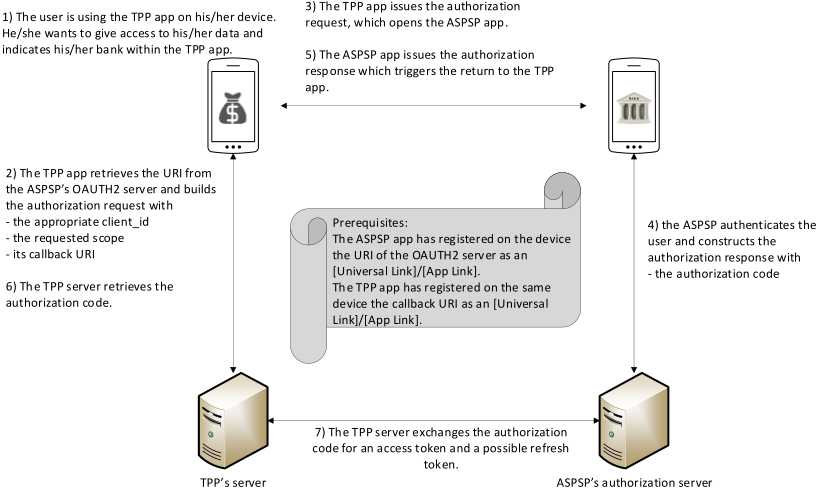
The RFC 8252 (https://tools.ietf.org/html/rfc8252) extends the use of the OAuth Authorization request to applications that are installed on a given device (e.g. a smartphone).
Based on this RFC, one might consider having a straight through authorization process by using
-
Universal Link (IOS based devices)
-
App Link (Android based devices)
However, the API specification does not mandate this mechanism.
3.4.3. AISP authorization levels
Since a TPP is acting on behalf of a PSU being a PAO, the PSD2 use cases that are linked with AISP role require the following authorization levels:
-
Authorization by Role
-
Authorization by TPP-PSU agreement
-
Authorization by PSU context
3.4.3.1. List of the relevant ASPSPs
When contracting with a TPP, the PSU will provide a list of the ASPSPs that it allows the TPP to
access. This list may not be exhaustive and so may not include some of the PSU's ASPSPs.
3.4.3.2. Registration of the TPP-PSU agreement by each ASPSP
This registration is due to enable the further access of the TPP to the PSU's data that is hosted by a given ASPSP by providing the TPP with an OAuth2 access token.
The access token can be retrieved by one of the following Grants:
-
OAuth2 Authorization Code grant (REDIRECT approach)
-
This grant can be enhanced with the following additional parameters borrowed from OpenID Connect:
-
[login_hint]
-
[ui_locales]
-
-
-
OpenID Connect Grant (REDIRECT approach)
-
Client Initiated Backchannel Authentication Grant (DECOUPLED approach)
Each ASPSP will have to document its own choice on this topic.
3.4.3.3. AISP OAuth2 Scopes
It is requested that AISP, CBPII or PISP roles will not be mixed within a single scope definition OAuth2 access token request.
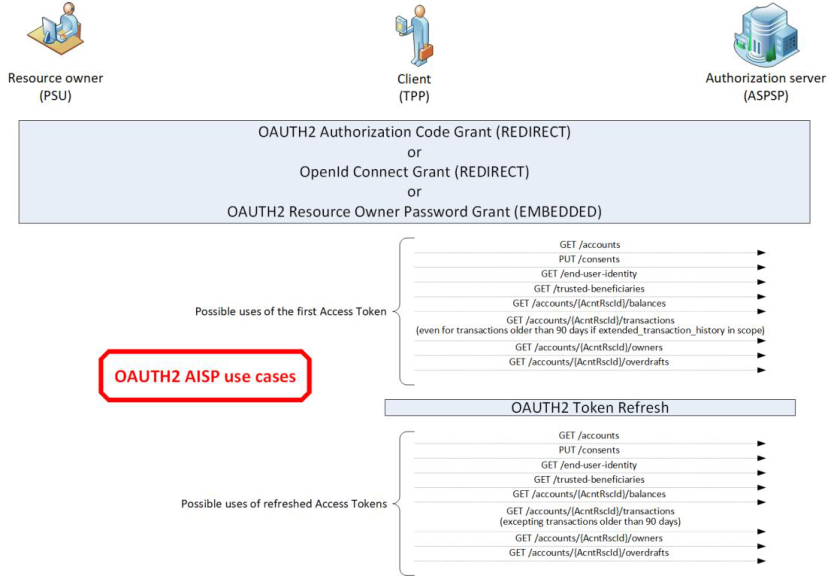
The OAuth2 scope requested by an AISP can be one of the following values:
-
"aisp"
-
"aisp extended_transaction_history"
The first scope value allows the AISP accessing all accessible accounts and data allowed by the PSU until expiration of the by-law specified delay between two SCAs. However, the value does not allow requesting an extended transaction history, i.e. history including transactions older than 90 days.
The second scope value allows the AISP accessing all accessible accounts and data allowed by the PSU until expiration of the by-law specified delay between two SCAs. It also allows requesting an extended transaction history.
However, this "aisp extended_transaction_history" scope will be restricted to "aisp" by the ASPSP during the first token refresh. Thus:
-
The AISP will be able to ask for an extended transaction history with the very first access token retrieved after a token request. So, in this case a single SCA will be required and used to get the token and to ask for an extended transaction history.
-
Any further extended transaction history request will be considered as out of scope (cf. §3.4.2)
3.4.3.4. PSU detailed consent
The PSU detailed consent will specify which account or functionality will be accessible to the AISP. It can be seen as a collection of individual accreditations.
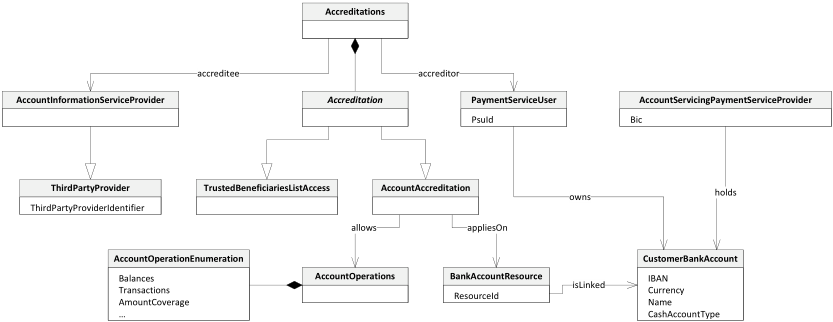
This collection is specific to a given PSU, a given TPP and a given ASPSP.
Each single accreditation relies on a specific account that is owned by the PSU and is held by the ASPSP. It specifies which pieces of data (transactions, balances) the TPP is allowed to carry out on this account.
The PSU manages this context with the AISP which is responsible of:
‒ The capture of the PSU choices:
-
The PSU specifies to the AISP which account and feature should be accessed or not.
-
The execution of the PSU choices:
- The AISP has the responsibility to respect the PSU choices and not to access any feature that it has not been granted for.
At any time, the PSU can edit his/her consent choices but this can only be done with the AISP.
Furthermore, the PSU consent may or may not be forwarded by the AISP to the ASPSP, according to one of the two following consent management models.
Full-AISP model (A1)
In this model, the ASPSP does not require to be informed of the details of the PSU consent.
Whatever the AISP request, the ASPSP will respond, being unable to check the compliance of the request against the PSU choices.
Actually, when getting the PSU context from the ASPSP (through the call [get /accounts]), the AISP will get all relevant HAL links and resource identifiers for each eligible account.
These HAL links will help the AISP to request the needed features on those accounts: balances and/or transactions.
Mixed model (A2)
In this model, the ASPSP does require to be informed of the details of the PSU consent. Therefore, the ASPSP has implemented an ad-hoc API entry-point that can be called by the AISP in order to forward the PSU choices.
Actually, when getting the PSU context from the ASPSP (through the call [get /accounts]), the AISP will get all eligible accounts but HAL links and resource identifiers will be provided only for the accounts on which consent was given by the PSU.
These HAL links will help the AISP to request the needed features on those accounts: balances and/or transactions.
Model choice
It is the charge of the ASPSP to implement or not the mixed model (A2). However, if this model has been implemented by the ASPSP, it is the charge of the AISP to forward the details of the PSU consent to the ASPSP whenever the PSU gives or edits this consent.
Once the details of the PSU consent has been received and saved by the ASPSP, the AISP, when getting the PSU context from the ASPSP (through the call [get /accounts]), will only get HAL links for authorized accounts and features.
3.4.4. CBPII authorization levels
Since a CBPII is acting on behalf of a PSU being a PAO, the PSD2 use cases that are linked with AISP and CBPII roles require the following authorization levels:
-
Authorization by Role
-
Authorization by TPP-PSU agreement
-
Authorization by PSU context
However, in some cases, the CBPII might have been previously enrolled by the PSU to the relevant ASPSP (cf. §3.4.4.3).
3.4.4.1. List of the relevant ASPSPs
When contracting with a TPP, the PSU will provide a list of the ASPSPs that it allows the TPP to access. This list may not be exhaustive and so may not include some of the PSU's ASPSPs.
3.4.4.2. Registration of the TPP-PSU agreement by each ASPSP
This registration is due to enable the further access of the TPP to the PSU's data that is hosted by a given ASPSP by providing the TPP with an OAuth2 access token.
The access token can be retrieved:
-
Either through an OAuth2 Authorization Code flow (REDIRECT approach)
-
OpenID Connect Grant (REDIRECT approach)
-
Client Initiated Backchannel Authentication Grant (DECOUPLED approach)
3.4.4.3. Pre-enrolled CBPII authorization level
When the PSU has previously enrolled the CBPII to his/her relevant ASPSP, the latest may prefer to apply a simpler authorization scheme.
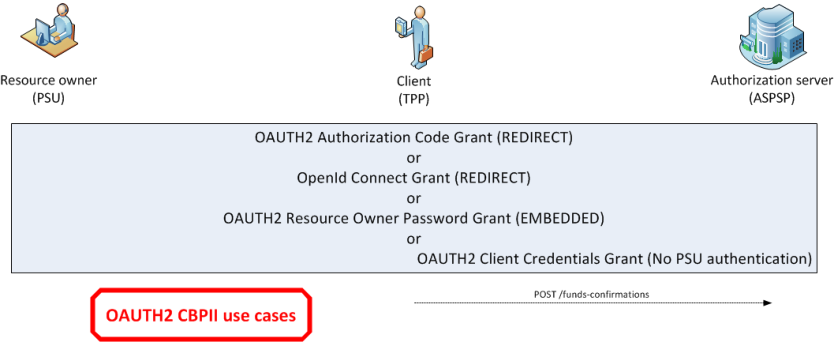
The access token can then be retrieved through an OAuth2 Client Credentials flow, aiming that PSU authentication is useless since the PSU consent was already captured.
3.4.4.4. CBPII scope
It is requested that AISP and CBPII roles will not be mixed within a single scope definition OAuth2 access token request.
The OAuth2 scope requested by a CBPII can only be "cbpii".
3.4.5. PISP authorization levels and Fraud Management
3.4.5.1. Use cases
Posting and getting a Payment/Transfer Request
For posting or getting a Payment Request on behalf of a Merchant, or a Transfer Request on behalf of an Ordering Party, the PISP can use an access token that can be retrieved from the ASPSP through an OAuth2 Client Credentials flow.
However, the execution of the payment request requires a confirmation:
-
From the PSU by a proper authentication
-
From the PISP itself after completion of its fraud risk analysis.
In this perspective, during the posting of the Payment Request, the PISP will have to suggest
the authentication approaches it supports. The ASPSP will then answer with the chosen authentication approach completed and the URL to be used for initiating the PSU authentication.
Confirmation of a Payment Request
This authentication shall be strong, unless exemption cases and can be performed through an ENFORCED REDIRECT or a DECOUPLED approach (cf. infra).
Once the PSU has confirmed the Payment Request to the ASPSP through this authentication, the PISP will get an access token. The PISP must use this access token for its own confirmation of the Payment Request after having checked, for instance, the absence of potential security flaw.
Cancellation of a Payment Request
In case the PISP has to cancel a payment request, the Access token to be used can be retrieved from the ASPSP through an OAuth2 Client Credentials flow.
However, the ASPSP may require a confirmation through an authentication of the PSU. This authentication can be performed through a SIMPLE REDIRECT or a DECOUPLED approach (cf. infra).
In this perspective, during the Cancellation Request, the PISP will have to suggest the authentication approaches it supports. The ASPSP will then answer:
-
either with the decision of not processing the PSU authentication; the cancellation is then effective
-
or with the chosen authentication approach completed with the URL to use for initiating the PSU authentication; the cancellation will be effective after this PSU authentication.
3.4.5.2. SIMPLE REDIRECT Approach
This approach can only be used for a Payment Request cancellation.
The PSU authentication is then processed through a simple redirection of the PSU to the ASPSP authentication server by using the URL that was initially provided by the ASPSP.
The ASPSP authenticates the PSU and then redirects the latest by using one of the call-back URLs that were provided by the PISP.
3.4.5.3. ENFORCED REDIRECT Approach
This approach is mandatory for a Payment Request confirmation in REDIRECT approach.
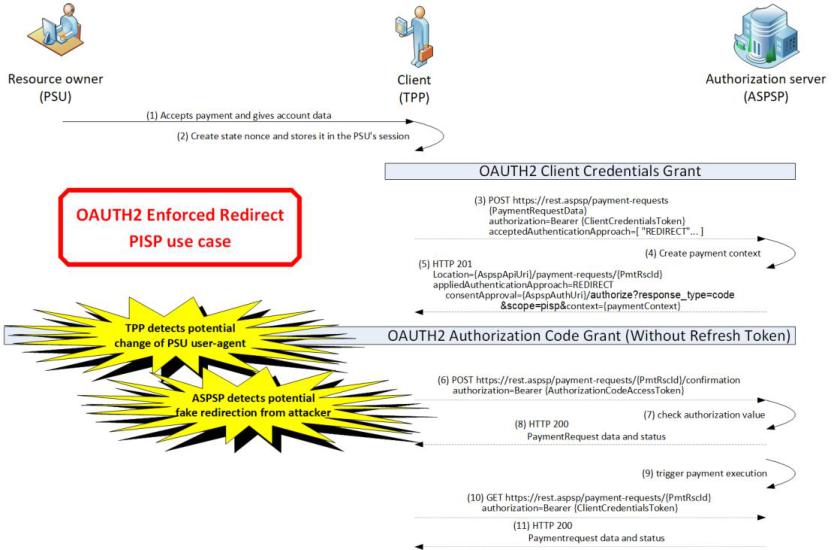
An Authorization Code token will be used for the confirmation. The PSU authentication is processed through the Authorization Code flow with the ASPSP authentication server.
Purpose and risk analysis
The payment initiation may indeed face some security issues in REDIRECT approach.
A first attack (session fixation) might happen, based on the fact that a given PSU will forward the redirection request to another PSU who can be in a situation to authenticate and pay the purchase made by the first PSU.
Moreover, even if the first attack is mitigated, the attacker might also try to simulate the redirection (fake redirect) to the TPP in order to induce the confirmation of the payment request to the ASPSP.
Session fixation protection
In order to avoid the session fixation attack, the PISP must ensure there is no "PSU-switch" during redirection. This can be done by managing a nonce that
-
will be stored in the PSU user agent session before the redirection to the ASPSP and
-
- will be retrieved from the PSU user agent after the redirection.
In case the retrieval failed, the chances are good there was such an attack. The PISP should then cancel the payment request for fraud reason.
Otherwise, in case of successful nonce retrieval, the PISP can confirm the payment request to the ASPSP who is then able to trigger the relevant Credit Transfers.
Fake redirect protection
In order to post the confirmation, the PISP has to request an Authorization Code token from the ASPSP.
In response to the payment request, The ASPSP has provided the PISP with the URI of the
Authorisation server. Some OAuth2 parameters must have been pre-valued:
-
[response_type] valued with "code"
-
[scope] valued with "pisp"
-
[context] valued with a hint to the payment-request
The PISP will complete this URL with its own OAuth2 parameters
-
[client_id]
-
[state] if needed
-
[redirect_uri] as call-back URL.
The OAuth2 Authorization Code grant can then complete (cf. §3.4.2.3).
After the retrieval of the Authorization Code through the redirection of the PSU back to the PISP, the latest must then ensure, by the nonce check mechanism, there was no "PSU-switch" during the redirection, as previously explained.
The PISP can then exchange the Authorization Code against the Access token.
-
the lifetime of the access token is specified by the Authorization Server in order to limit the usability period.
-
no refresh token has to be provided.
The confirmation is then posted, using this Access token.
In case of face redirect attack, the Access token could not have been retrieved by the PISP. Even in confirmation attempt, the ASPSP can detect the absence of the token and will then reject the payment request for FRAUD reason.
Otherwise, the confirmation sent by the PISP will lead to the normal triggering of the relevant Credit Transfers.
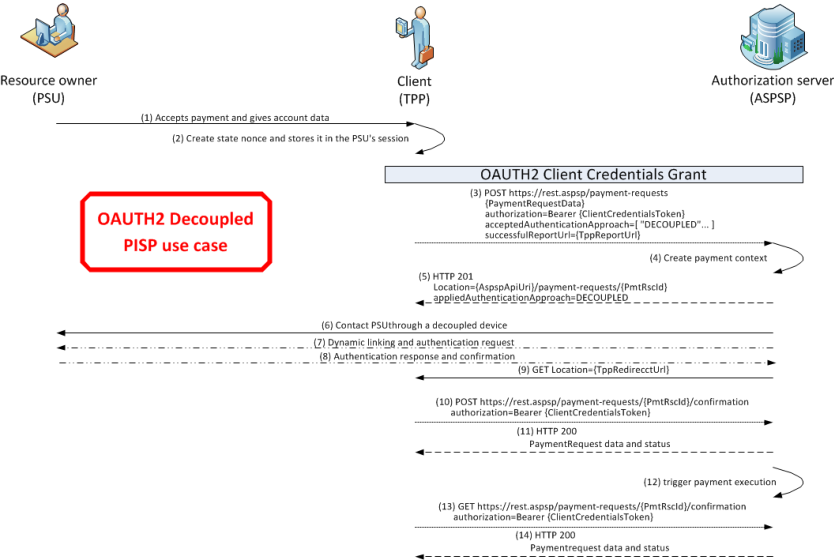
3.4.5.4. OAuth2 DECOUPLED Approach
In this approach, the Client Credential token can be used for all PISP use cases:
-
Posting a payment request
-
Getting the previously posted payment-request
-
Modifying for cancellation the payment request
-
Confirming the payment request
The PSU authentication is processed through a decoupled channel initiated by the ASPSP.
After PSU authentication, the PISP is informed by a direct call by the ASPSP. The PISP can then confirm the payment request that will lead to the normal triggering of the relevant Credit Transfers.
3.4.5.5. Recapitulative Table
| SIMPLE REDIRECT | ENFORCED REDIRECT | DECOUPLED | |
|---|---|---|---|
| Nonce mechanism protection applied by PISP | The nonce must be computed by the PISP and stored within the PSU user-agent as far as the PISP accepts Simple REDIRECT or Enforced REDIRECT approaches when posting or cancelling a payment request. |
| SIMPLE REDIRECT | ENFORCED REDIRECT | DECOUPLED | |
|---|---|---|---|
| Successful and Unsuccessful Report Uri provided by PISP | To be used by the ASPSP through PSU redirection | To be used directly by the ASPSP after PSU authentication | |
| Accepted Authentication Approach set by PISP | Must include "REDIRECT" | Must include "DECOUPLED" | |
| Applied Authentication Approach set by ASPSP | "REDIRECT" | "DECOUPLED" | |
| PSU authentication | For confirmation of a cancellation | For confirmation of a Payment Request |
3.5. Applicative authentication
Each request sent by the TPP has to be signed and ASPSP might also apply sign their responses.
If the ASPSP notes that the signature is either absent or invalid for a given request, it shall reject this request with HTTP400.
If the TPP notes that the signature is invalid for a given response, it shall warn the relevant ASPSP.
3.5.1. Http-Signature Mechanism
Http-signature mechanism is specified by the following IETF draft-paper:
- https://datatracker.ietf.org/doc/draft cavage http signatures/
One must notice that this IETF draft-paper has now been replaced by a new draft :
However, since OpenBankingEurope and ETSI, together with several PSD2 API inititiatives including STET, published a new signature standard, it is strongly advice to consider replacing http-signature by this new signature standard (cf. 3.5.2).
3.5.1.1. Signature computation
The way it should be implemented is the following
- Computing a SHA256 digest of the HTTP body and adding this digest as an extra HTTP header.
-
Using a specific Qualified Certificate (QSealC), respecting the ETSI/TS119495 Technical Specification, in order to apply an RSA-SHA256 signature on
-
all the following headers that are present within the HTTP request sent by the TPP, including the previously computed digest
-
Date (if available)
-
Content-Type (when there is a payload)
-
Content-Length (when there is a payload)
-
X-Request-Id
-
All available "PSU"-prefixed Headers (cf. § 3.5.2)
-
the specific "(request-target)" pseudo-header which is specified by the IETF draft-paper
-
-
all the following headers that are present within the HTTP response given by the ASPSP, including the previously computed digest
-
Date (if available)
-
Content-Type (when there is a payload)
-
Content-Length (if available)
-
X-Request-Id
-
-
-
Adding this signature within an extra HTTP header embedding
-
The key identifier which must specify the way to get the relevant qualified certificate (see below)
-
The algorithm that has been used
-
The list of headers that have been signed
-
The signature itself.
-
Since version #11 of the draft, two new pseudo-headers have been introduced in order to
strengthen the signature: (created) and (expires). However, work is still going on this subject and the use of these two fields is not yet recommended.
| EXTRA HTTP HEADER | DATA | COMMENT |
|---|---|---|
| Digest | Digest of the body | |
| Signature | http-signature of the request (cf. https://datatracker.ietf.org/doc/draft-cavage-http- signatures/) |
3.5.1.2. Value of key identifier
It is requested that this identifier is valued with:
-
Either the keyId that has been assigned by the authorization server during the OAuth2 technical setup (cf. § 3.4.2.2).
-
Either a URL aiming to provide the relevant Qualified Certificate.
-
In order to assure an easy discrimination of the certificate among others, it is requested that the last part of the URL to the certificate be suffixed by an underscore followed by the SHA-256 fingerprint of the certificate.
- E.g.: https://path.to/myQsealCertificate_714f8154ec259ac40b8a9786c9908 488b2582b68b17e865fede4636d726b709f
-
This URL could have been provided during the OAuth2 technical setup within the "5xu" field of the JKS provided by the TPP (cf. RFC7517).
-
3.5.2. JSON Web Signature Profile for Open Banking
This signature mechanism is specified by the following document:
It relies on the use of a Json Web Signature (JWS as specified by RFC7515).
The way it should be implemented is the following
-
Choosing a Qualified Certificate (QSealC), respecting the ETSI/TS119495 Technical Specification and belonging to the sender of the request or the response as signing certificate.
-
Choosing a signature Algorithm among those listed in both RFC7518 and ETSI TS 119 312, although a regular review of potential weaknesses of these algorithms is highly recommended.
-
Computing a SHA256 digest of the HTTP body and adding this digest as an extra HTTP header.
-
Building a JWS protected header whose
-
[sigD/pars] field will list all the lower-case HTTP header fields to be signed (see below) and encoding it into Base64url.
-
[x5t#S256] field will be valued with the Base64url encoded hash of the previously chosen signing certificate
-
[alg] field will be valued with the signature algorithm name
-
Building the HTTP header string as the list of all headers/values to be signed.
-
-
oall the following headers that are present within the HTTP request sent by the TPP, including the previously computed digest-
Date (if available)
-
Content-Type (when there is a payload)
-
-
Content-Length (when there is a payload)
-
X-Request-Id
-
All available "PSU"-prefixed Headers (cf. § 3.5.2)
-
the specific "(request-target)" pseudo-header which is specified by the IETF draft-paper
-
all the following headers that are present within the HTTP response given by the ASPSP, including the previously computed digest
-
Date (if available)
-
Content-Type (when there is a payload)
-
Content-Length (if available)
-
X-Request-Id
-
-
Concatenating the Base64url encoded JWS protected header and the HTTP header string with a dot (".") as separator.
-
Computing the signature, using the chosen certificate and algorithm, on the previous concatenation result.
-
Concatenating the Base64url encoded JWS protected header and the resulting signature with a double-dot ("..") as separator
Adding the previous concatenation result as an extra "x-jws-signature" HTTP header
3.6. Fraud-detection-oriented information
The following extra HTTP-headers must be used within the HTTP request sent by the TPP, provided the relevant pieces of data are available within the connection between the PSU and the TPP. This forwarding allows the ASPSP to integrate this information into its own fraud detection process.
Moreover, these headers can be considered as proof of the PSU being connected.
| EXTRA HTTP HEADER | DATA | COMMENT |
|---|---|---|
| PSU-IP-Address | IP Address of the PSU terminal when connecting to the TPP | In regards with GDPR rules, this must be subject to PSU's consent |
| PSU-IP-Port | IP Port of the PSU terminal when connecting to the TPP | |
| PSU-HTTP-Method | HTTP Method used for the most relevant PSU's terminal request to the TTP | |
| PSU-Date | Timestamp of the most relevant PSU's terminal request to the TTP | |
| PSU-User-Agent | "User-Agent" header field sent by the PSU terminal when connecting to the TPP | |
| PSU-Referer | "Referer" header field sent by the PSU terminal when connecting to the TPP | |
| PSU-Accept | "Accept" header field sent by the PSU terminal when connecting to the TPP | |
| PSU-Accept-Charset | "Accept-Charset" header field sent by the PSU terminal when connecting to the TPP | |
| PSU-Accept-Encoding | "Accept-Encoding" header field sent by the PSU terminal when connecting to the TPP | |
| PSU-Accept-Language | "Accept-Language" header field sent by the PSU terminal when connecting to the TPP | |
| PSU-GEO-Location | The forwarded Geo Location of the corresponding HTTP request between PSU and TPP if available. | In regards with GDPR rules, this must be subject to PSU's consent |
PSU-Device-ID | UUID (Universally Unique Identifier) for a device, which is used by the PSU, if available. UUID identifies either a device or a device dependant application installation. In case of installation identification this ID need to be unaltered until removal from device. | In regards with GDPR rules, this must be subject to PSU's consent |
3.7. Other specific HTTP headers to be used
| EXTRA HTTP HEADER | DATA | COMMENT | |
|---|---|---|---|
| X-Request-ID | Correlation header to be set in a request and retrieved in the relevant response. | ||
| Idempotency-Key | Idempotency key to be added by the API client for ensuring that a given request, when retried twice or more, will indeed only be executed once by the API server. This applies especially on POST requests. | The rules for uniqueness, validity and expiry must be set according to: https://datatracker.ietf.org/doc/draft-ietf-httpapi- idempotency-key-header/ |
3.8. Specific HTTP return codes and messages to be used
| MESSAGE | HTTP CODE | SIGNIFIANCE |
|---|---|---|
| FORMAT_ERROR | 400 | Format of certain request fields are not matching the XS2A requirements. An explicit path to the corresponding field might be added in the return message. |
| RESOURCE_UNKNOWN | 404 | If resourceId in path |
| PERIOD_INVALID | 400 | Requested time period out of bound. |
| MESSAGE | HTTP CODE | SIGNIFIANCE |
|---|---|---|
| ACCESS_EXCEEDED | 429 | The access on the account has been exceeding the consented multiplicity per day. |
| REQUESTED_FORMATS _INVALID | 406 | The requested formats in the Accept header entry are not matching the formats offered by the ASPSP. |
3.9. STET PSD2 API technical summary
| TOPIC | CHOICE | COMMENT | |
|---|---|---|---|
| Access network | Internet | ||
| Network protocol | HTTP 1.1 (Minimum) | ||
| Data encryption Cross-authentication | TLS 1.2 | Could be enforced through STS and/or PFS | |
| Authorization protocol | In respect of RFC 6749, 7009 One of the following token modes - Authorization Code Grant (AISP, CBPII and PISP) for REDIRECT approach - Client credential (PISP, CBPII) Based on MTLS,the identity of the TPP is provided by its eIDAS certificate during OAuth2 procedures. https://datatracker.ietf.org/doc/rfc8705/ The OpenId Connect extension can also be used in place Authorization Code Grant The Client Initiated Backchannel Authorization Grant can be used in order to implement a DECOUPLED approach | ||
| - | |||
| - | |||
| OAuth2 | Based on | ||
| its eIDAS | |||
| Applicative protocol | REST | In respect of the Richardson Maturity Model, on level three in order to provide HYPERMEDIA links. | |
| Applicative authentication | http-signature | Notice this is actually an | |
| PSU Strong Customer Authentication approaches | REDIRECT, DECOUPLED | ||
| Data format | JSON/UTF8 | With use of ISO20022 based data structures | |
| Technical documentation | SWAGGER 2.0 | Date/Time format must respect ISO8601 and RFC3339 in accordance with OpenApi specifications. The creator of a Date/Time shall choose - Any time-zone format although UTC format is recommended. - Any second fraction format, including no second fraction. A simple date can be specified as an UTC date/time with a time part equal to "00:00:00Z". The recipient of a Date/Time must be able to interpret its value as far as it is compliant with ISO8601 and RFC3339. |